Buddy GPT
Tools
Claude Code
Python
Product Design
Description
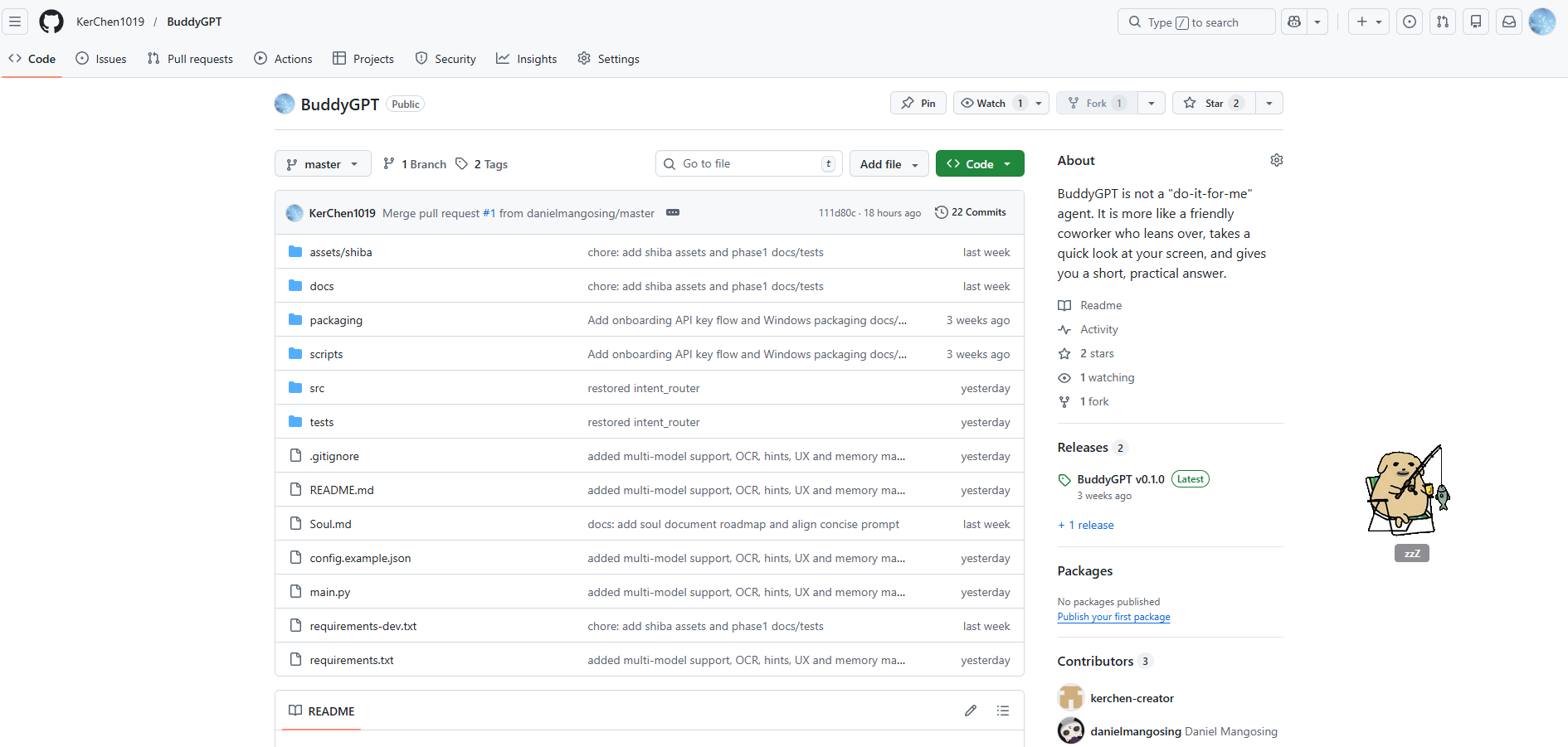
BuddyGPT is not a "do-it-for-me" agent. It is more like a friendly coworker who leans over, takes a quick look at your screen, and gives you a short, practical answer.
The original pain point was simple: I was asking ChatGPT a lot of practical questions, but each time I had to manually take screenshots or copy/paste email context before I could ask.
BuddyGPT removes that repetitive overhead. Instead of "screenshot -> copy context -> paste -> ask", you wake the dog and ask directly, so the whole flow feels smoother and more natural.

As an AI Artist and Technical Artist, I often find myself thinking about a simple question:
How should AI exist within a creator’s working environment?
Most of my work happens remotely, and my daily workflow involves constantly moving between different tools: researching references in a browser, reading technical documentation, experimenting with models, writing small scripts, and documenting ideas. In this kind of environment, AI has become an important part of how I process information. At the same time, I’ve noticed that many AI tools today are designed primarily as agents—systems that attempt to execute tasks automatically, complete workflows, or even make decisions on behalf of the user.
For my own practice, that direction isn’t what interests me the most.
When I’m researching or creating, I don’t necessarily want AI to complete the work for me. Most of the time, I simply need a small nudge when I get stuck, or a quick explanation of something complex. The core thinking and judgment should still come from the human side.
Because of this, I became interested in the idea of an AI coworker.
BuddyGPT is a project I explored around this concept. Instead of building a fully autonomous AI agent, it attempts to position AI as something closer to a colleague within the working environment. The system can read the current screen, active window, or clipboard content to understand what the user is looking at. With a simple hotkey, the AI already has the minimal context needed to respond—almost like a coworker sitting next to you who can quickly explain or comment on what’s on your screen.
Within this design, personality plays an important role.
BuddyGPT appears as a small companion on the desktop. Occasionally it pushes AI-related news, and when needed, it offers assistance. The goal isn’t to make the AI feel more “intelligent,” but rather to make it feel present yet unobtrusive—something that exists alongside your workflow without trying to control it.
I intentionally avoided designing it as a fully automated AI agent.
Instead, I see it as a low-friction collaborator: when you need it, it’s there; when you don’t, it quietly stays in the corner of your screen.
While exploring and implementing this project, two technical considerations became especially important to me.
The first is Privacy Control. As a freelancer, I often work on multiple client projects on the same machine, some of which involve sensitive or unpublished material. Because of that, I’m particularly cautious about how AI tools handle local data. BuddyGPT supports running local models, which makes it possible to use AI in certain scenarios without sending information to external services.
The second is Token Efficiency. After spending a significant amount of time working with API-based models, I realized that tokens are not just a cost issue—they also shape how systems should be designed. Many AI applications send large amounts of context to the model by default. BuddyGPT takes a different approach by only sending the necessary information, such as the current screenshot or clipboard content, rather than the entire working environment. This made me think more carefully about how information should be structured in AI systems.
For me, this project ultimately became a kind of workflow experiment.
It led me to rethink a broader question: if AI is not just another application we open, but something that quietly exists within our working environment, what kind of relationship might develop between humans and AI?
I don’t believe AI should replace creators.
But I do believe it can become something closer to a coworker—someone you can talk to whenever you need a second perspective.